
In partnership with

issue #25 | date: 10/29/2025

Editors Note
I'll never forget the moment I realized I had executive presence but nobody knew it.
I was in a leadership offsite, sitting next to a VP who'd been with the company for years. We were discussing a major org restructure when the CEO asked: "What do we think about consolidating these teams?"
Silence.
I had a clear opinion. I'd spent months working across both orgs. I knew the risks, the dependencies, the people dynamics. But I hesitated—waiting for someone more senior to speak first.
The VP next to me leaned forward and said almost exactly what I was thinking. The CEO nodded. "Great point. Let's move forward with that."
After the meeting, the VP pulled me aside: "You knew that too, didn't you? I could see it on your face. Why didn't you say anything?"
Good question.
I had the judgment. I had the expertise. I had earned my seat at that table. But I wasn't showing any of it.
In this issue:
The gap between having executive presence and demonstrating it
How to signal authority without being performative
Tactical ways to make your presence felt in the room
Jobs for people who've mastered showing up like an executive
The importance of staying firm on your values
Psychological biases against human misjudgement
Let's close that gap.
Phedra Arthur Iruke
Editor in Chief
The Simplest Way to Create and Launch AI Agents and Apps

You know that AI can help you automate your work, but you just don't know how to get started.
With Lindy, you can build AI agents and apps in minutes simply by describing what you want in plain English.
→ "Create a booking platform for my business."
→ "Automate my sales outreach."
→ "Create a weekly summary about each employee's performance and send it as an email."
From inbound lead qualification to AI-powered customer support and full-blown apps, Lindy has hundreds of agents that are ready to work for you 24/7/365.
Stop doing repetitive tasks manually. Let Lindy automate workflows, save time, and grow your business
Featured Job Listings
🏆 Top Picks of the Week (Hand-Picked, High-Impact Roles)
🔹 Leadership Roles (Talent Pool)
Company: n8n
Location: Remote – Berlin/EU, United States & United Kingdom
Apply: Apply Here
n8n, the open-source AI orchestration platform, maintains a Leadership Talent Pool to connect with exceptional leaders for future Director, Head, and VP roles. This pool isn’t tied to a specific opening but welcomes experienced leaders in go-to-market, product, engineering, operations, or people functions. Ideal candidates have a proven track record of building and scaling high-performing teams, setting strategic direction, and driving execution with empathy, transparency, and ownership. Benefits include competitive pay, equity, generous vacation, and health coverage.
🔹 Director of PMO & Operations
Company: inDrive
Location: London, UK
Format: Hybrid
Apply: Apply Here
Reporting to the Chief Ride-Hailing Officer, this role drives business planning, leads the Market Operations PMO, and ensures risk management and operational efficiency across inDrive’s ride-hailing division. The Director manages budgeting, procurement, and process improvement while aligning operations with corporate strategy. Requires 7 + years of experience in business or project management (preferably in tech or mobility), strong analytical skills, and fluency in English and Russian.
🔹 Head of Delivery, Americas
Company: SimCorp
Location: New York, NY
Format: Hybrid (3 days per week in office)
Apply: Apply Here
SimCorp seeks a Head of Delivery to oversee program delivery across the Americas. The role ensures efficient, high-quality execution, leads client relationships, manages escalations, and drives standardization across delivery teams. Requires strong program-management and leadership experience in complex enterprise environments and the ability to collaborate globally with senior stakeholders.
🔹 Head of Public Sector Delivery – GenAI
Company: Scale AI
Location: Washington, DC
Format: On-site with ~30 % travel
Apply: Apply Here
Scale AI is hiring a Head of Public Sector Delivery to lead AI/ML solutions for government clients. This player-coach role manages engagement and technical program managers, refines delivery processes, mitigates risk, and deepens client relationships. Requires an active TS/SCI clearance, 8 + years of customer-facing technical program management (preferably AI or government), and strong leadership skills.
🔹 Head of Events
Company: Brex
Location: New York, NY
Format: Hybrid (2 office days per week; remote up to 4 weeks/year)
Apply: Apply Here
Brex seeks a Head of Events to design and lead its global event strategy for brand visibility and customer engagement. The leader manages large-scale conferences, partner activations, and executive events while aligning programming with company goals. Requires 8 + years in event marketing or strategy, experience leading teams and budgets, and ability to travel up to 50 %.
🔹 Head of Transformation Office
Company: MarketAxess
Location: New York, NY
Format: Full-time
Apply: Apply Here
MarketAxess is hiring a Head of Transformation Office to drive enterprise-wide transformation initiatives and establish a centralized PMO. Responsibilities include leading strategic change programs, defining delivery governance, setting KPIs, and tracking performance across portfolios. Ideal candidates have 15 + years’ experience leading transformation in financial services, expertise in PMO setup and governance, and exceptional communication skills.
📌 IC & Manager Roles
Role | Company | Location (City, State) | Format | Apply |
|---|---|---|---|---|
Customer Onboarding Project Manager | Filevine | Salt Lake City, UT | On‑site | |
Project Coordinator | Base Power Company | Austin, TX | On‑site | |
Product Operations Lead | Snorkel AI | New York City, NY; Redwood City, CA; San Francisco, CA or Remote (US) | Hybrid or Remote | |
Business Operations & Strategy | Tailscale | Remote, Canada | Remote | |
Business Operations Associate | Honeydew | Remote (US) | Remote | |
Technical Program Manager | Pryon | New York City, NY (remote) | Remote | |
Senior Technical Program Manager | DigitalOcean | Denver, CO | Hybrid/Remote | |
Technical Program Manager | IPSY | United States (Remote) | Remote | |
Project Manager | CAI (Computer Aid, Inc.) | Trenton, NJ | Hybrid (one day on‑site) | |
Project Manager | Lincoln Property Company | Charlotte, NC | Hybrid | |
Implementation Manager | OpenAsset (Axomic) | New York, NY | Hybrid | |
Implementation Consultant | Avispa Technology | Chicago, IL (Hybrid worksite may be Chicago or New York) | Hybrid |
Experience the Next Evolution of AI Intelligence

Watch The Worlds First AI Built for Cognitive Amplification live on October 15.
See how Pressmaster.ai turns one conversation into thirty days of authentic and impactful content.
Register free to join the launch event and experience the future of AI communication.
Bots Take the Wheel
🤖 Auto-Flag At-Risk Projects Before They Blow Up
The Problem: By the time you realize a project is off track, it's already in crisis mode and everyone's scrambling.
The Fix: Automate early warning signals so at-risk projects surface before they become fires.
Real Use Cases:
Jira + Slack: Auto-Alert on Velocity Drop
Logic: Track team velocity weekly. If velocity drops >20% for 2 consecutive weeks, auto-post alert to #delivery-leadership with affected projects
How: Jira Automation → Scheduled trigger (weekly) → Calculate story points completed vs. average → If velocity < 80% of baseline for 2 weeks → Post Slack alert with project details, team lead tagged
Impact: Surfaces capacity issues early. Teams can intervene before missing major milestones.
Asana + Email: Flag Projects with Overdue Tasks >5 Days
Logic: Every Monday, scan all active projects. If >3 tasks are overdue by 5+ days, email project owner + program manager with summary
How: Zapier → Schedule (Monday 8 AM) → Asana search for projects with overdue tasks → Count tasks overdue >5 days → If count > 3, send email digest with task list and owners
Impact: Prevents silent project drift. Forces accountability conversations before deadlines slip further.
ServiceNow + Dashboard: Real-Time Project Health Score
Logic: Calculate project health score based on: schedule variance, budget variance, blocker count, and stakeholder sentiment. Update dashboard hourly. Auto-escalate if score drops below threshold.
How: ServiceNow Flow Designer → Hourly trigger → Query project data (milestones, budget, blockers) → Calculate weighted health score → If score < 60/100, create incident ticket and notify PMO lead
Impact: Creates objective project health visibility. Removes "everything is fine" status updates that hide real problems.
TL;DR: Stop relying on weekly status reports to surface project risks. Automate the signals that predict failure—velocity drops, overdue tasks, blocker accumulation—so you can intervene early instead of cleaning up disasters.
Visionary Voices
📝 Sumaiya Balbale: Standing Firm on Values While Building Bridges in Tech

Standing Firm on Values While Building Bridges in Tech
In a powerful display of principled leadership, Sumaiya Balbale made headlines this past August when she resigned from her role as Chief Operating Officer at Sequoia Capital after five years with the prestigious venture capital firm. But this departure—driven by standing firm on her values as a practicing Muslim woman—represents just the latest chapter in a career defined by strategic pivots and fearless industry jumps.
The Art of Strategic Career Moves
Balbale's career trajectory reads like a masterclass in strategic positioning. She has consistently followed her mentors' advice to "pick hard paths," noting: "I learned what I am capable of. If you jump into something and don't have a lifeline, you figure out how to swim."
Her journey began in advertising, working as a brand strategist and account planner at FCB and Deutsch for clients like IKEA, Novartis, and SC Johnson. But rather than climbing the traditional agency ladder, she made her first bold pivot into e-commerce.
The Amazon Acquisition Play
From 2010 through 2014, Balbale worked for Quidsi, a collection of specialty e-commerce verticals, serving in leadership roles at Amazon e-commerce verticals including GM of Diapers.com and Casa.com. This wasn't just a job change—it was positioning herself at the center of e-commerce innovation during its explosive growth phase.
The Jet.com Leap
Perhaps her boldest early career move came in 2014. Balbale left her established position to become Chief Marketing Officer of Jet.com, an e-commerce startup founded by Marc Lore. This wasn't just another startup—she was betting on a founder with a proven track record, but taking the significant risk of joining an unproven company.
The bet paid off spectacularly. Walmart acquired Jet for $3.3 billion in 2016 and retained key players, including Lore and Balbale. This acquisition positioned her for her next major leap.
The Walmart Scale-Up
Rather than cashing out after the acquisition, Balbale continued operating in a dual capacity for both Jet.com and Walmart during the first year of the acquisition, before becoming VP of E-commerce, Mobile and Digital Marketing for Walmart US from 2017 to 2019.
The results were staggering: She helped deliver two consecutive years of +40% growth for the e-commerce business while also leading and transforming the digital media, social media, marketing analytics and marketing technology capabilities of the organization.
The Venture Capital Industry Jump
In her most audacious career move, Balbale left her position at Walmart in June 2019 and transitioned to an entirely new industry, accepting the role of CMO at Sequoia Capital in 2020. This wasn't just a job change—it was a complete industry pivot from retail operations to venture capital.
Close advisers encouraged the e-commerce veteran to make the industry switch, believing risky career moves could dispel stereotypes about Muslim women. As she explained: "I felt the urge to achieve significance—despite how insignificant others seemed to want to make me feel."
Recognition and Board Leadership
Her strategic career positioning paid off with significant recognition. She was named one of Fortune's 40 under 40 in 2018, and has served on the Board of Directors of Shake Shack since March 2019.
Lessons for Delivery Leaders
Balbale's career offers five critical insights for ambitious delivery professionals:
1. Strategic Industry Timing: She didn't just change jobs—she positioned herself in growth industries (e-commerce, venture capital) at inflection points.
2. Acquisition-Driven Growth: Her moves from Quidsi to Jet.com to Walmart show how to leverage acquisitions for career acceleration.
3. Operational Excellence as Currency: Her track record of delivering measurable results (+40% growth) became her calling card for bigger opportunities.
4. Cross-Industry Translation: Her jump from retail operations to venture capital demonstrates how operational expertise translates across industries.
5. Values-Driven Decision Making: Her principled departure from Sequoia shows that staying true to your values, even when costly, can define lasting impact.
The Bigger Picture
Balbale has spoken about how "my gender, ethnicity and faith compelled me to be ambitious in a way that I don't know if I otherwise would have been." Her career arc—from advertising strategist to venture capital COO—proves that delivery professionals who think strategically about positioning and aren't afraid of industry jumps can achieve extraordinary influence.
For our community, Balbale represents the evolution from tactical executor to strategic architect. She's proof that the best career moves aren't always up—sometimes they're across, into industries and roles that amplify your operational strengths in new ways.
Have a visionary leader you'd like us to feature? Reply and let us know who's inspiring you in the world of delivery and implementation.

Gif by nickatnite on Giphy
✨ Weekly Recommendations
Master the art of building unshakeable trust with engineering teams through this comprehensive technical program manager playbook.
Trump's economic policies could turn America into a high-stakes casino where working families are forced to gamble with their future.
Despite feeling overwhelmed by technological progress, you are not late to the innovation party—the best opportunities are still ahead.
Charlie Munger's legendary talk reveals the psychological biases behind human misjudgment that derail even the smartest decision-makers.
This top venture capitalist bet nearly 20% of his fund on teenagers, and his reasoning will change how you think about young founders.
In partnership with Askalawyeroncall.com
“Your secret weapon for high-stakes delivery work.”
You’re negotiating SOWs, vendor contracts, and NDAs — but don’t have in-house counsel on speed dial.
AskALawyerOnCall.com gives you exactly that.
Flat-fee answers.
No gatekeeping.
No surprises.
Professional Development
📚 How to Show Your Executive Presence
Here's the uncomfortable truth:
You might already have executive presence. You might have the judgment, the expertise, the strategic thinking.
But if people don't see it, it doesn't exist.
Executive presence isn't just about being capable. It's about signaling capability in ways that land with the right people at the right moments.
Let's talk about how to show what you've already built.
1. The Problem: You're Waiting for Permission to Be Seen
Most delivery professionals with strong executive presence make the same mistake:
They wait to be asked before sharing their expertise.
They defer to "more senior" people in meetings.
They assume good work will speak for itself.
It won't.
Here's what actually happens when you stay quiet:
Leaders assume you don't have a strong opinion
Decisions get made without your input
Less qualified people with more confidence fill the void
You get frustrated that your judgment isn't valued
The Reality:
Executive presence isn't about having good judgment. It's about demonstrating it at the moments that matter.
2. The Three Signals of Executive Presence
People evaluate executive presence through three channels:
How you show up (body language, tone, energy)
What you say (substance, clarity, judgment)
What you don't say (restraint, listening, strategic silence)
Let's break down each one.
Signal 1: How You Show Up
The mistake most people make:
They think executive presence means being louder, more confident, more assertive.
The reality:
Executive presence is about calm authority. It's the energy that says: "I've seen this before. I know how to handle it."
Tactical Ways to Show Up:
A. Control Your Physical Space
Sit at the table, not against the wall (even in hybrid meetings, be on camera)
Keep your posture open—no crossed arms, no hunching
Make eye contact when you speak (or look at the camera in virtual meetings)
Take up space physically (spread your materials, gesture naturally)
B. Manage Your Energy
Speak at a measured pace (rushing signals anxiety)
Lower your vocal pitch slightly (higher pitches signal nervousness)
Pause before responding to big questions (shows you're thinking, not reacting)
Stay calm when others panic (this is the #1 signal of executive presence)
C. Read the Room
Notice who has influence and align your energy with theirs
Match the pace of conversation (don't rush a slow-moving executive discussion)
Lean in during key moments to signal engagement
Use silence strategically—don't fill every gap
Example:
Bad: You're in an exec meeting. Someone asks a hard question. You immediately jump in with an answer, talking fast, trying to prove you know the answer.
Good: You pause. You lean forward slightly. You say: "Good question. Here's what I'd consider..." Then you walk through your thinking clearly and concisely.
The difference? The second approach signals: "I've thought about this deeply. I'm not reacting—I'm analyzing."
Signal 2: What You Say
The mistake most people make:
They over-explain. They provide too much detail. They sound tactical, not strategic.
The reality:
Executives value clarity and decisiveness. They don't want to hear every step of your process. They want to know: What's your call? Why? What happens next?
Tactical Ways to Communicate Like an Executive:
A. Lead with the Bottom Line
Structure every statement like this:
The Call: What you recommend
The Why: 1-2 sentences of rationale
The Action: What happens next
Example:
Tactical (doesn't land):
"So we've been analyzing the data and looking at different options, and there are some pros and cons to each approach. On one hand, we could do X, but that has risks. On the other hand, Y might work but it'll take longer. I think we need to discuss..."
Executive (lands):
"I recommend we move forward with approach X. It carries some execution risk, but it's the only path that gets us to launch by Q2. I'll own mitigation. Next step is aligning engineering leads by Friday."
The difference? The second version signals decisiveness and ownership.
B. Use "I Recommend" Instead of "I Think"
"I think" sounds tentative.
"I recommend" sounds decisive.
C. Speak in Outcomes, Not Activities
Executives don't care about tasks. They care about results.
Tactical: "We've been running sprints, doing standups, and tracking velocity."
Executive: "We're on track to ship by EOQ with 95% confidence."
Tactical: "We're planning to have a meeting with stakeholders."
Executive: "We're aligning stakeholders on the go/no-go decision by Wednesday."
The pattern: Outcomes > Activities.
D. Use the "Three-Point Rule"
Executives have short attention spans. If you give them 7 points, they'll remember 0.
Instead, structure everything in threes:
"There are three risks we're managing..."
"Here are the three options..."
"I need three things from this group..."
Why it works: It's memorable, it's concise, and it signals you've done the thinking.
E. Own the Hard Truths
Executive presence isn't about sugarcoating problems. It's about stating them clearly and owning the path forward.
Weak: "We're facing some challenges with the timeline..."
Strong: "We're going to miss the original date. Here's why, and here's the new plan."
The pattern: State the problem clearly. Own the solution. Don't hedge.
Signal 3: What You Don't Say (Strategic Silence)
The mistake most people make:
They feel pressure to contribute to every conversation. They comment on everything. They never let silence sit.
The reality:
Restraint is a form of executive presence.
Knowing when not to speak signals:
You're confident enough not to prove yourself constantly
You're discerning about when your input adds value
You respect others' expertise
Tactical Ways to Use Silence:
A. Don't Comment on Everything
If 10 topics come up in a meeting, speak on 2-3. Choose the moments where:
You have unique expertise
The decision is consequential
No one else is saying what needs to be said
Why it works: When you speak less frequently, people listen more carefully.
B. Let Silence Do the Work
After you make a key point, stop talking. Don't fill the silence with more explanation.
Example:
You: "I recommend we kill this project. It's not aligned with our strategy, and continuing will cost us 6 months."
[Silence]
[Let them sit with it. Don't immediately add: "But I mean, we could keep going if you think..." That kills your authority.]
C. Ask Questions Instead of Giving Answers
Sometimes the most powerful move is to reframe the conversation with a question.
Instead of: "Here's what I think we should do..."
Try: "Before we decide, what outcome are we optimizing for here?"
Why it works: It signals strategic thinking. You're forcing the room to clarify first principles before jumping to tactics.
D. Use "Let Me Think on That"
If you don't have a strong opinion yet, don't fake one.
Say: "Good question. Let me think on that and get back to you tomorrow."
Why it works: It signals thoughtfulness over reactivity. Executives don't need to have instant answers. They need to have right answers.
3. How to "Show Up" in Different Contexts
Executive presence plays differently depending on the setting. Here's how to calibrate:
A. In 1:1s with Executives
Come prepared with 2-3 key topics (don't wing it)
Lead with "Here's what I need from you" (not "Let me update you on everything")
Be crisp—execs value brevity
If they ask a hard question, pause before answering (shows you're thinking, not scrambling)
B. In Executive Meetings
Speak early (within first 15 minutes) to establish presence
Choose 1-2 moments to weigh in substantively (not every topic)
When you speak, be decisive ("I recommend..." not "I think maybe...")
Use data to back claims, but don't drown them in details
C. In Cross-Functional Meetings
Position yourself as the connector (not just the executor)
Translate between functions ("What engineering is saying is..." or "From a business perspective...")
Offer to own next steps (shows leadership, not just participation)
D. In Writing (Emails, Docs, Slack)
Use the "BLUF" format (Bottom Line Up Front): Lead with the ask or the decision
Keep executive emails under 5 sentences
In docs, use executive summaries with TL;DR at the top
Bold key points for scannability
Example Email:
Bad:
"Hi Team, I wanted to follow up on our conversation from last week about the project timeline. As you know, we've been tracking progress and there are some concerns..."
Good:
"Decision needed: Recommend pushing launch from June 15 → July 1 due to engineering dependencies. Allows us to ship without cutting scope. Need approval by EOD Friday."
4. The "Presence Multipliers"
These are the small behaviors that 10x your executive presence:
A. Own the Room Early
In every meeting, say something substantive within the first 10 minutes. It doesn't have to be long—even a clarifying question signals engagement.
Why it works: People form impressions fast. If you're silent for 30 minutes, they've already categorized you as "not a key player."
B. Reframe the Conversation
When discussions get stuck in the weeds, bring them back to strategy.
"Before we go further, let's level-set: What's the outcome we're trying to drive here?"
Why it works: It signals strategic thinking and leadership.
C. Summarize and Synthesize
After a long, meandering discussion, be the person who says:
"Let me make sure I've got this: We've agreed on X, we're still debating Y, and the next step is Z. Is that right?"
Why it works: You're creating clarity. That's an executive-level skill.
D. Follow Through Visibly
If you say you'll do something, do it—and make sure people know you did it.
Send the follow-up. Share the doc. Close the loop.
Why it works: Reliability is the foundation of executive presence. If you can't be trusted to follow through, nothing else matters.
5. How to Recover When You Don't Show Up Well
Everyone has off days. Here's how to recover:
If you stayed too quiet in a key meeting:
Follow up with a thoughtful email sharing your perspective
Book 1:1 time with decision-makers to weigh in directly
If you over-explained or got too tactical:
Send a crisp summary doc afterward with the exec-level takeaway
In the next meeting, be more concise
If you said something wrong or got called out:
Own it immediately: "You're right—I was off on that. Here's what I should have said..."
Don't get defensive. Executives respect people who can admit mistakes.
6. The Biggest Mistake: Confusing Presence with Performance
Here's the trap: You think if you just do great work, people will see your executive presence.
They won't.
Great work is table stakes. Executive presence is about how you show up around the work.
You can deliver flawlessly and still be seen as "tactical" if you:
Don't speak up in key moments
Don't communicate strategically
Don't signal confidence and decisiveness
Conversely, you can have some execution gaps and still be seen as "executive-level" if you:
Own problems clearly
Communicate with clarity and conviction
Make good calls under pressure
The lesson: Work on both. Execute well and show up well.
TL;DR: Executive presence isn't about being louder or more confident. It's about signaling calm authority through how you show up (body language, energy), what you say (clarity, decisiveness), and what you don't say (strategic silence). Lead with the bottom line. Speak in outcomes, not activities. Use restraint. And most importantly: if you have good judgment, make sure people see it at the moments that matter. Great work alone isn't enough—you have to show them you're executive-level.
🤝 Support the Community
Community: Submit a recommendation by replying to this email!
Leaders: Apply to be featured by replying to this email.
Recruiters/Hiring Managers: Get your job in front our community. You got it - just hit reply.
If you’re reading this on the web, feel free to send an email to [email protected]
▶ Buy us a coffee so we can keep doing this.
▶ Got something cool? Let’s get it out there.
▶ Was this email forwarded to you?
How I can Help
Wanna chat IRL? Connect with me on LinkedIn and we can set up some time.
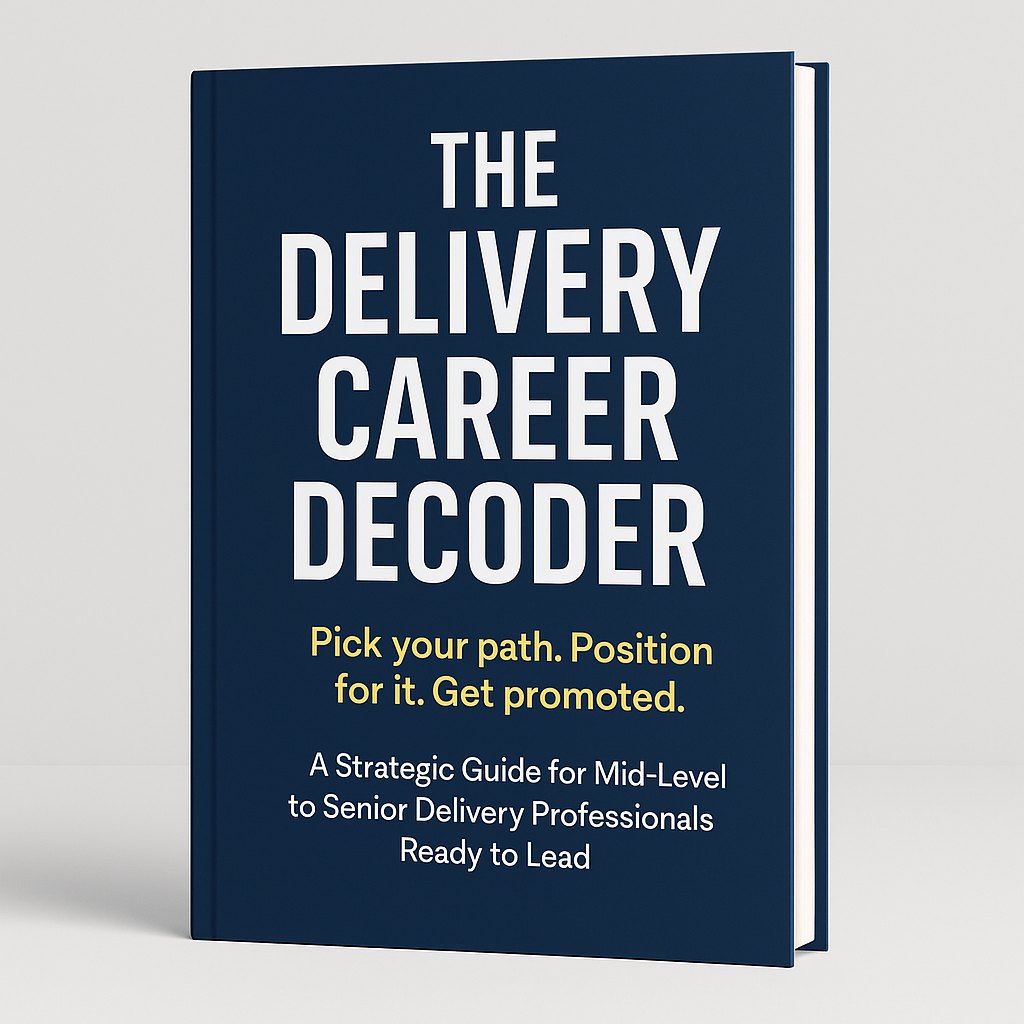
The Delivery Career Decoder shows why you’re already qualified for more—and how to prove it.
I love feedback. If you have topics you want to see? Or thoughts or ideas on how to serve the community better, please hit reply or email [email protected].
Until next time,
The Business of Delivery
Quiet moves. Bold Careers.